4
Aug

20
Jul

7
Jul

25
Jun
I picked up IDW’s first Archie Comics collection, The Best of Dan DeCarlo Volume 1. Since no one has yet posted a list of the contents, I thought I’d have a go at it.
Before I do, I’ll give some brief thoughts: the biggest quibble is that there are only 26 stories here, and they barely scratch the surface of DeCarlo’s output in the years 1958-1969. It’s limited to Betty and Veronica stories (DeCarlo had that almost exclusively, but also contributed to many other titles), and while almost all of them are good, not all of them can really be called standouts. However, I’m assuming that the choice of stories was dictated in part by which stories had original art available. Many of these stories look lovely, especially the late ’50s/early ’60s material when DeCarlo was at his best, and a comparison with an old copy of one of the comics seems to suggest that they’ve done a good job of reproducing the original colours.
The most pleasing thing, as I said elsewhere, is that the table of contents includes credits for all the stories, which originally appeared uncredited. DeCarlo got to sign his name alongside Stan Lee’s when he was at Marvel, doing Millie the Model, but at Archie he never got credit for anything except a tiny “By Dan n’ Dick” credit on some of the Josie comics. (Dick being the editor, Richard Goldwater.) That restores credit not only for DeCarlo, but for his main inker, Rudy Lapick, for his brother Vince DeCarlo, who did most of the letters, and above all Frank Doyle, who is credited here with writing 23 of the 26 stories — and the story for which the credit reads “writer unknown” might also be a Doyle script.
I’ve always been a fan of Doyle ever since I read his credited work in the ’80s, but his earlier, uncredited work is even better; it’s his writing that really elevates the best of these stories. DeCarlo is excellent here, sexy and funny and smooth, though by the end of the volume you can see how his slickness and polish sort of settled into a “factory” style (the early stories have much livelier and funnier drawing). But his drawing for Archie wasn’t any better than his work for Timely/Marvel, and if you want to argue that Millie the Model represents his very best drawing, I wouldn’t really disagree. But though Stan Lee’s writing on the Marvel/Timely humor titles certainly wasn’t bad, Doyle’s best stuff is in a different league (from Lee’s humour comics, I said — I’m not talking about the action/superhero stuff), with simple yet smart dialogue that’s not on-the-nose awkward like most comic book dialogue, a storytelling style that favours observational humour over plot mechanics, and lots of visual opportunities for DeCarlo.
I’ve compared Doyle’s work to “Seinfeld” because, on a smaller scale, he has that ability to build stories around tiny details of social life and relationships, or the way people can get obsessed with petty things. (That’s why the stories sound pretty basic when I summarize them, but have a much stronger profile when you read them.) The definitive story in the book, “Snob Sister,” is just five pages of Veronica showing Betty the different ways in which people can be “snobbish.” It’s simple, it’s fun, and it just comes off as a little smarter and sharper than any of the Archie imitators of the era.
So yes, there are a bunch of stories I would have liked to see in this volume that aren’t there. And fans of “good girl” art may be a bit disappointed that there are so few beach stories. But if you’re not a buff on this kind of comic, it’s a reasonably-priced introduction to DeCarlo’s art and the “good” years of Archie comics in general. And the decision to include credits is, as I said, something that fills me with a lot of good will. IDW has further Archie collections planned, including Bob Montana’s newspaper strip — which is where the Archie “house style” was really created — and a “Best of Stan Goldberg” collection with Stan Lee writing the foreword (this volume doesn’t have a foreword). I hope this one sells enough to justify more artist-themed collections and, in time, perhaps more DeCarlo collections; we really need a collection of his best post-Marvel work, the early, funny, pre-Pussycats Josie.
Here then are the contents. All scripts are by Frank Doyle unless otherwise noted:
1. “Birth of a Notion” (Betty and Veronica # 37, July 1958) – The boys toss around a doll and fool the girls into thinking they’re tossing around a baby. (Script: Sy Reit)
2. “Flip Flopped” (Betty and Veronica # 38, September 1958) – Veronica signs up for the cheerleading squad.
3. “Sheep Skinned” (Betty and Veronica # 44, August 1959) – The boys accuse the girls of being “sheep” for following the latest fashions.
4. “A Choice Choice” (Betty and Veronica Annual # 8, 1960) – Archie has to break his date with Veronica to take his mother out on her birthday.
5. “Something to Remember” (Betty and Veronica # 63, March 1961) – Veronica is peeved because Archie can never remember what she wears.
6. “The Reader Knows Best” (Betty and Veronica # 63) – Archie tries to do the same task for both Betty and Veronica, while assuring the reader that he knows what he’s doing.
7. “The Bluest Angel” (Betty and Veronica # 63) – Betty feels guilty about exploiting a misunderstanding between Archie and Veronica.
8. “Gambler’s Luck” (Betty and Veronica # 65, May 1961) – The girls toss a coin to see who gets Archie.
9. “Snob Sister” (Betty and Veronica # 69, September 1961) – Veronica argues that everyone is a snob about something or other.
10. “Switchcraft” (Betty and Veronica # 69) – Veronica thanks Betty for taking Archie off her hands.
11. “The Original” (Betty and Veronica # 77, May 1962) – Veronica explains that she doesn’t wear real jewels in public. (Credit reads “Writer unknown,” though it might also be Doyle)
12. “Commercial Caper” (Betty and Veronica # 83, November 1962) – Betty blows up “Archie Loves Betty” balloons.
13. “Glad To Help” (Betty and Veronica # 86, February 1963) – Archie tries to use Betty to make Veronica jealous.
14. “Dear Diary” (Archie Giant Series # 23, September 1963) – Betty writes her version of the day’s events in her diary.
15. “Sugar Doll” (Betty and Veronica # 103, July 1964) – Veronica tries to make candy.
16. “Heat Wave” (Betty and Veronica # 106, October 1964) – Archie, Betty and Veronica spend a hot day squirting each other with hoses.
17. “Bully Girl” (Betty and Veronica # 106) – Veronica shows off her new martial arts skills by beating up everyone in sight.
18. “The Midas Mess” (Betty and Veronica # 112, April 1965) – Everything Betty touches turns to gold.
19. “Prize Package” (Betty and Veronica # 112) – Betty tells Archie he’s won a “most popular boy” contest.
20. “Message Center” (Betty and Veronica # 116, August 1965) – Betty sees a message on the bulletin board saying Miss Grundy wants to see her after school.
21. “The Phenomenon” (Betty and Veronica # 117, September 1965) – Betty and Archie discover that when Veronica stands on her head, her speech balloons are upside down.
22. “Rhyme Time” (Betty and Veronica # 119, November 1965) – The narrator re-introduces us to the Archie gang, in rhyme.
23. “Do No Evil” (reprinted in Archie Giant Series # 137, January 1966 — but from the look of it it’s clearly an earlier story, probably from 1960 or so) – After the girls accuse them of being slobs, Archie and Reggie try to get revenge.
24. “Feed Deed” (Betty and Veronica # 130, October 1966) – At the beach, Veronica tries to outdo Betty’s cooking. (Script: George Gladir)
25. “Wing It” (Betty and Veronica # 155, November 1968) – Betty impresses the boys with her great throwing arm.
26. “Drive To Distraction” (Betty and Veronica # 167, November 1969) – Archie uses a beach umbrella to give Veronica some shade in his car.
23
Jun

8
Jun

27
May

15
May
The one thing Archie Andrews can be thankful for is that Betty Cooper doesn’t (usually) have god-like magical powers that allow her to kill or maim other people on a whim. Harvey… er… No-Last-Name is not so lucky. As revealed in this story from Sabrina # 21 (September 1974), written by Frank Doyle and drawn by Stan Goldberg before his characters’ faces started melting, Sabrina has adopted a policy of talking nice to her boyfriend while quietly using her Satanic powers to wreak destruction on any girl who even looks his way.
The violence begins in the splash panel, as Sabrina congratulates herself on her own lack of jealousy while literally raining thunder and lightning down on this poor girl whose only crime was to be (inexplicably) interested in Harvey. The whole thing has a “why don’t you stop drenching and electrocuting yourself” feel too it.

Then, after the girl has made it clear that she’s been thoroughly scared away, Sabrina tries to murder her by making a heavy sign fall on top of her. Just for the hell (again, literally) of it. Also, “Eeyipe!” was clearly a favourite Frank Doyle word along with “EEP!” “Urk!” and “W-ell.”

The freckled hell-spawn then returns to telling her poor sap of a boyfriend how wonderful he is, but senses danger when a stranger winks at him. So of course she does what anyone would do in a situation like that: causes her to have an entire supply of garbage poured onto her. I guess she was allowed to escape without any permanent scars only because she didn’t actually talk to him.


And, as the story ends, we see Sabrina casually destroying the lives, bodies and futures of literally every other young woman in sight, because it’s better to turn them into reptiles amphibians or cast them down to the centre of the Earth rather than risk having them talk to a guy who would later be played by Nate Richert. (Whatever happened to Nate Richert anyway?) I think my favourite image is of the girl being pulled into a mysterious building with a “girls wanted” sign. Apparently Sabrina is also using her witchcraft to sell women into prostitution.

I just wonder what Betty Cooper would do if she had supernatural powers. How could she ever top Sabrina’s combination of cruelty, viciousness and pathology?

I’m sorry I asked.
12
May

28
Apr
Since people were wishing for the return of Improved Archie, here it is, in very very basic form:

Have at it in comments.
Also, I’m looking for artists for a couple of projects – you know the email if you’re interested in working with me.
26
Apr


24
Mar
Every so often I get a comment on my blog that makes blogging worthwhile. One of them is this comment I got on a post about comic book artist Samm Schwartz:
I’m Sam Schwartz’s daughter. I googled him and was surprised to see a substantial number of hits. I think it’s terrific that people are still talking about him!
(No, she’s not mis-spelling her father’s name; as his Wikipedia entry notes, his name was actually “Sam,” and most people called him that in everyday life, but at some point in the ’40s he started signing his drawings “Samm.”)
Well, that got me thinking a bit more about Schwartz, the first comic book artist whose style I could identify as a child. And so did this post by veteran artist/inker Kevin Nowlan about some pages of original Schwartz art and how good Schwartz was at making characters fall down. So I decided I’d comment on a different Schwartz story:
Now, one thing that I can’t really put into words is that Jughead has a bigger range in Schwartz’s stories than he does elsewhere. He’s not exactly a character you can do a lot with, visually, but Samm always seemed to understand how much could be conveyed by having him open his eyes at the right time (or open his eyes halfway instead of all the way), or putting some extra folds in his very simplified clothes.
But the story does illustrate a few tricks Schwartz was in love with:
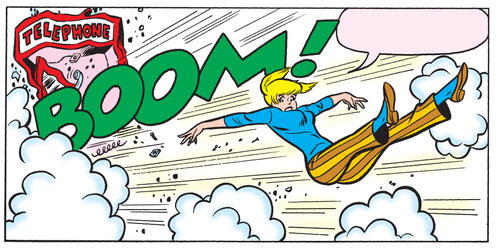
1. Letting the characters violate the panel boundaries. This wasn’t a new technique or anything; it was especially common in the Golden Age. But as the technique became less common, Schwartz started to use it more often to put extra interest into the pages. After he left DC and came back to Archie in 1969, he used this in virtually all his stories. Characters’ legs and arms simply go wherever they want to go.

2. Silhouetting. There’s actually only one silhouette bit in this story, which is unusually low for Schwartz; his motto was “when in doubt, silhouette,” and there’s one story where he just did an entire page of nothing but silhouettes. I don’t know if he did it as an experiment or if he was just running behind schedule, but it sure caught my eye as a kid.
3. Eliminating panel lines and backgrounds. This story has no plot — like a number of Frank Doyle scripts, it’s just two guys talking about not a whole lot. But there is a structural spine to the script, as Jughead becomes more and more angry about the scenario he imagines. (It helps that he’s basically right. Archie is an idiot and this is exactly what he would do.) And as Jughead gets more involved in acting out this scenario, Schwartz sometimes lets multiple Jugheads float across a white space as he gets caught up in his fantasy.

4. Keeping stuff out of view. It’s Archie, rather than Jughead, who does this here, but Schwartz sometimes liked to figure out what he could get away with not putting in the panel. So Archie has a rubbery, broad reaction to Jughead’s line — but all we see of him are his legs; otherwise we’re left to imagine what his reaction was. In the late Joe Edwards’ interview with Jim Amash in Alter Ego magazine — which is a treasure trove of information about MLJ/Archie — he recalled “a story where the dogs were chasing [one of the characters], running, and Sam drew the panel so all you saw was the tail wagging.”

IDW will presumably get around to doing a Schwartz collection in their upcoming Archie artist tribute series; in the meantime, here’s Schwartz in his own words. In 1980 he wrote the following to a young aspiring writer, Craig Boldman, who now writes the Jughead comic book (this quote is courtesy of Boldman, who hopefully will put the original letter up on his website).
I think of this as an acknowledgement that his spare, stripped-down style was not because he couldn’t draw any other way, but because he didn’t want anything to detract from his ability to sell the jokes.
And, for an example of Schwartz’s later work, this silhouette-filled 1980 story was always one of my favourites in the decades old “Jughead plays cruel psychological mind games on Reggie” genre. (You know, if it weren’t for the fact that all his friends are idiots who deserve this kind of treatment, Jughead would be kind of a dick.) Note the background gag on page 5: as a paper airplane crashes to the ground, a tiny pilot apparently parachutes out of it. And that’s pretty normal compared to some of the other unscripted stuff Schwartz drew into the halls of that high school.
8
Mar
Jaime found this and passed it along:

It’s the blissful expression on Betty’s face, combined with the sheer terror on Archie’s, that really sells the last panel. Her parents are away on a weekend vacation. Jughead is in Shelbyville at a chess tournament. Veronica is distracted, thanks to tipping off Reggie that Archie would be “otherwise occupied.” Moose and Dilton are useless. Archie is all hers, and as she lies glibly to Ronnie, she knows at last the sweet taste of triumph.
24
Feb
Okay, so let’s say I told you that in 1964, a comic book character was so out of control that the doctor prescribed tranquilizers. Let’s also say that this character started taking the tranquilizers and immediately became prone to narcolepsy. And let’s throw in the fact that even in a state of drug-induced narcolepsy, this person couldn’t stop stalking two other characters and making their lives miserable. Which character do you think I’m talking about?
I’ll give you three gu… aw, hell, you’ve guessed it already, haven’t you (click on thumbnails to read the pages).
The story more or less speaks for itself. Well, the ending might need a bit of explanation. Suffice it to say that tranquilizers, sedatives and other knock-out pills were at the height of popularity in the early ’60s. So a comic book about two teenagers choosing to take someone else’s clearly dangerous prescription drugs? Not a problem. I mean, it’s not like they’re drinking beer or something.
And a question for experts on Betty Cooper’s mental state: do you think her doctor prescribed this incredibly strong medication because he was trying to take her out of commission, or is this just the dosage she prefers?
Finally, those who like spotting hidden messages in old comics might note the names and initials on the bench:

“Dan” and “Josie” are Dan DeCarlo and his wife (yes, that’s where he got the name) while “Rudy” and “Mary” are DeCarlo’s inker Rudy Lapick and his wife. “Harry” is probably Harry Lucey. And LBJ might or might not be a politician of some kind. That one’s for comics historians to decide.
18
Feb
You know what surprises me about remakes in comic books? It’s that there haven’t been more of them. Formula or no formula, there does usually seem to be a presumption that a new script is better than re-illustrating an old one from a decade earlier. Which is a good thing; I’m just not sure if it reflects integrity or the fear that someone might notice. Anyway, Archie comics had surprisingly few out-and-out remakes for a franchise where a lot of the stories kind of feel like remakes. But there have been a few exceptions, starting with two versions of one script that told us the same thing: if you don’t learn a foreign language, people will die.
The first time this script appeared was in 1960, in Archie # 114, a story that inspired one of the most famous Harry Lucey covers (Ren and Stimpy creator John Kricfalusi, a Lucey admirer, featured it in his blog’s Lucey cover gallery.) The company at this time was going through one of their very brief flirtations with having the cover actually be related to the stories inside, instead of being a stand-alone gag…

…but, like most such covers, it gives a false impression of what’s going to happen; we think Archie’s going to be arrested, but then we open the book and find:
Pretty straightforward message: you may not like studying Spanish, but you should learn it anyway. Why? Because when a kid gets hit by a car, every single other person in the crowd will have been too apathetic to learn Spanish themselves, and you’ll be literally the only one who can talk to the kid’s father and find out his blood type. That seems hard to argue with.
The story must have made an impact on someone at the company, or they just wanted to do something like it and didn’t have time to get a new script: because sometime in the late ’60s (judging by the art and clothes, it looks like 1969 or so), they did it again.
Archie’s R sweater and bow tie are gone and Betty is now wearing miniskirts, but the art is basically the same, though there are enough new poses to suggest that it was re-drawn rather than just re-inked from the old drawings. (I’m sorry that I couldn’t get them side-by-side for direct comparisons.) Lucey, who was an excellent superhero/action artist and is credited with having done some Captain America work in the ’40s, still draws the authority figures (the cop, the surgeon) in a less cartoony style than usual. But what we learn primarily is that despite all the social upheaval between the beginning and end of the ’60s, there’s still no one except Archie who can speak Spanish.
Now, as I said, comic books wouldn’t normally dust off an old script and do it verbatim; they’d do a similar story with a new script. And that’s what they did sometime in the mid-’70s, in the adventure-laden world of Life With Archie (I don’t know which issue). The script is identifiable as the tireless Frank Doyle — basically, if someone says “EEP!” it’s probably him — but the art this time is by Stan Goldberg.
The art is streets ahead of what Goldberg is turning out now, though I much prefer Lucey’s take on the characters, and you notice that his use of very prominent face lines is already getting out of hand: on page 6, panel 3, it makes Veronica look weird. But the art is not all that’s changed. Now there’s a new reason for learning Spanish. Not because a kid will get hit by a car, but because a hemophiliac kid will get a cut and you will be the only one who knows he isn’t a sissy for getting upset. And whereas in the ’60s it was reward enough to “be proud of yourself,” in the ’70s, that’s just not enough unless you also get a big kiss from the kid’s hot older sister.
But here’s where it gets strange. What’s Archie Comics’ attitude towards other languages besides Spanish? Well, as this late ’50s story from Wilbur (written by Doyle, art by Dan DeCarlo) will show, it’s extremely negative.
According to the comics, and contradicting everything I was told in the Ontario school system, French has no practical use whatsoever, and even people who speak French don’t actually care about teaching it, they just want to score with younger boys.
So, to review: if you don’t learn Spanish, the blood of dead children is on your hands. But watch out for French. It’s dangerous.

"By MightyGodKing, we mean sexiest blog in western civilization."
-- Jenn