People who know me know that I continue to be concerned that the transition to streaming services is actually providing less choice to film viewers rather than more. This is not a new hobby horse I’m riding, of course, but my opinion isn’t changing as time goes on, and the reason was recently illustrated to me all over again.
You may or may not be aware that Edgar Wright, he of Cornetto Trilogy fame and other movies that are mostly good also, last year did a list on Mubi of his thousand favorite films. (Here it is on Letterboxd if you want to clone it for your own Letterboxd. Also I’m on Letterboxd and that’s where my movie reviews and thoughts mostly are these days, mostly because I am finding now that sometimes I don’t remember if I’ve seen a movie from twenty to thirty years ago or not, which is a fun thing to recognize when you’re only 41.) It’s an interesting list. Some people are taking it as a list of One Thousand Great Films, which is stupid because Domino is on it and literally the only good thing about that movie is Keira Knightley saying “my name is Dahmino Hahvey and I am a bounty huntah.” Also it has The Artist on it, and the best thing about that movie is that it ended and then conclusively determined once and for all that the Oscars are a sham. But just because it isn’t necessarily full of movies that are actually good doesn’t mean it’s not an interesting list, curated by someone who really loves movies, and when you’re in the mood to take a deep dive into the movie pool, lists like this are extraordinarily helpful.
So yesterday I was in the mood for such a dive, and I went through the list and found Dark of the Sun, a 1968 action movie about mercenaries in the Congo. (The trailer is here.) The online word about the movie was that it was entertaining and that it had a scene where two guys fight each other with goddamn chainsaws, and I thought that sounded just fine to me, so I went hunting for it.
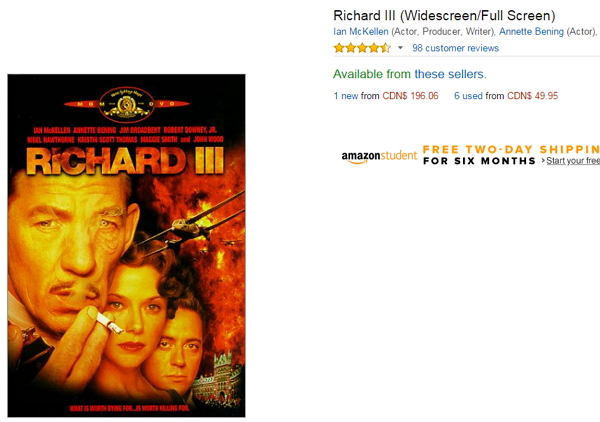
The problem, of course, is obvious: it isn’t on anything. It’s not on any streaming service in Canada. You can’t virtually rent it on iTunes or Google Play or Windows Media rental or Cineplex.com or even on the Playstation Network’s movie library. (I only occasionally do Google Play rentals and don’t use the other services, but if I wanted to sign up, they aren’t helpful.) There’s a couple of “free movie” streaming sites that advertise it, but I’m pretty sure I have enough malware on my computer already so I’m not doing that. Basically, if I want to see Dark of the Sun based on Edgar Wright’s recommendation and a liking of the idea of a chainsaw duel, I have to track down a copy of the DVD, and I’m not so sure I want to see it that I want to spend $20 on a used DVD (the going price on Amazon.ca’s resellers).
After considering this, I wondered at the rest of the list. It’s not your typical best-of movie list, because this is Edgar Wright’s favorite movies instead, which means there are, among other things, three Russ Meyer films on it. And a lot more horror than average, too, along with a fair dollop of Hong Kong action cinema. And because Wright is English the list skews English more than other lists might, and also has a little more European influence on it, and for films you often don’t see on “best of” lists to boot. And there’s some stuff on it which is simply just average, like the 1973 Burt Reynolds action film White Lightning, but every average action movie has people who love it beyond reason. (Mine is Posse.) All of this, combined with the impressive size of the list, means that Edgar Wright’s list is a reasonably random selection of movies. It biases a little towards certain genres and it’s perhaps a little heavier towards the modern day than it is towards the early years of cinema, proportionally speaking, but it’s a big slice of film that isn’t specific, which means it’s a pretty good sample.
So I took this sample, and asked a simple question: how much of it can I watch online? I set some rules for this. First off, I didn’t count movies illegally streaming on Youtube or on malware-bait movie sites as being online; I only want to count films that I can legally watch online with as clear a conscience as I can manage. “I could torrent it” doesn’t count for the same reason. I also didn’t count movies I could either stream or download by using a VPN to proxy myself into another country, both because it again seems like a violation of the rules and because most streaming and rental services are actively blocking a lot of VPN proxy servers anyways. I then distinguished between movies I could watch via a subscription streaming service in Canada, and movies I could only watch via use of an online rental service like Google Play or iTunes.
Here are the takeways:
Firstly: 223 of Wright’s thousand movies cannot be streamed in Canada in any way whatsoever. No streaming service has them and you can’t rent them at any pay-per-rental/buy-into-your-digital-library service. This includes Dark of the Sun, of course, but also a whole bunch of other titles. Some of the highlights (?) include:
| Movie | Why It's Significant | RottenTomatoes |
|---|---|---|
| The Passion of Joan of Arc | one of the most critically-praised of all silent films | 97% |
| Un Chien Andalou | Luis Bunuel and Salvador Dali's silent masterpiece | 100% |
| Monkey Business | one of the best Marx Brothers films | 94% |
| Sons of the Desert | the greatest of all Laurel and Hardy feature films | 100% |
| Fantasia | Disney's orchestral masterpiece | 96% |
| The Bank Dick | W.C. Fields' most popular work | 100% |
| Notorious | Hitchcock directing Cary Grant for the first time | 97% |
| Kind Hearts and Coronets | #6 on the BFI's Top British Films of All Time | 100% |
| Godzilla | it's O.G. – motherfucking original Godzilla | 83% |
| Rififi | the French heist film from which many others copy | 94% |
| Red Desert | Michelangelo Antonioni's most brilliant work with colour | 100% |
| Straw Dogs | the original Peckinpah/Hoffman rather than the remake | 91% |
| Sleeper | Woody Allen's sci-fi comedy | 100% |
| Young Frankenstein | this one not being available blew my mind | 93% |
| Sorcerer | William Friedkin's existential action thriller | 80% |
| Dawn Of The Dead | you can watch Zach Snyder's remake but not Romero's original | 93% |
| All That Jazz | Bob Fosse's filmic masterpiece | 85% |
| A Better Tomorrow | the reason John Woo and Chow Yun-Fat had careers | 93% |
| Near Dark | Kathryn Bigelow's amazing vampire flick | 88% |
| Withnail and I | Richard E. Grant was never better than in this | 93% |
| Crimes and Misdemeanors | I still can't believe Woody Allen made a film with this title | 93% |
| The Wrong Trousers | along with all the other Wallace and Gromit shorts | 100% |
| The Legend of Drunken Master | the single best Jackie Chan movie ever | 83% |
| Happiness | Todd Solondz' masterwork of bleakness | 85% |
| In The Mood For Love | one of the most critically successful films of the past twenty years | 98% |
| Spirited Away | probably Hayao Miyazaki's most acclaimed film | 97% |
And I could add another thirty films you’d recognize to that list whose inclusion would surprise you. The most recent film from Wright’s list which is not available to stream in any capacity in Canada is Michael, from 2011.
After those 223 films, there are another 475 films which can only be streamed via a pay-per-rental/library service such as iTunes or Google Play. None of the major streaming services have all of the titles, of course. Google Play has the most (382 of the 475 pay titles accessible), but every service has a few exclusives. Not all of the titles are rentable; some are purchase-only (iTunes in particular does this more often than the others do). It’s also important to note that the overwhelming majority of stuff available on the streaming services is also available via the pay-per-title services as well, but I didn’t keep a running tally of which providers duplicated which streaming services’ options (although Google and iTunes unsurprisingly had far more at a glance than the others did).
Finally, we come to the streaming services, which is probably what people most wanted to know about – and no, Netflix isn’t the one with the most. That honour – in Canada, at least, where we spell honour with a U – goes to TMN Go, our national equivalent of HBO Go, with 106 titles. TMN Go’s diversity of selection is easily the best among any of the streamers, with a good mix of classics and newer releases (many of which are shared in common with Netflix). Netflix comes in second with 80 titles, the vast majority of which are less than fifteen years old. (Netflix’s oldest entry on the list is The Grapes of Wrath from 1940.) Netflix’s recency bias is so strong that were Wright to repeat this exercise in twenty years with a “my 1500 favorite movies of all time” I think their overall share of titles would likely decrease.
After TMN Go and Netflix, the selection gets smaller fast. Third place with 48 titles goes to Tubi, AKA “that free service on your smart TV you never click on,” and because it’s a free service most of their selections are older movies but that’s a pleasant bonus rather than a chore in this case. Next is Fandor, a service for older films and foreign films which I had literally never heard of before doing this exercise, with 33, then Amazon Prime Video with 31 (the Canadian version of Amazon Prime is much less good than the American version, for those wondering). Rounding out the smallest streaming services we have the horror streaming service Shudder with 20, Sundance Now with 17, the CBC’s ici.tou.TV French-language streaming service with 13, and finally Crackle, Sony’s half-assed free network, with 10.
At this point in the blogpost you’re probably expecting me to walk around holding up the big WHAT IT ALL MEANS neon sign, except I’m not sure what it means. I can say a few things affirmatively, though.
One is that Google Play (in particular) has ramped up their library dramatically over the past three years and that their rights system (from what I know of it) tends to encourage stability, because anybody with film rights can just treat Google Play as an additional revenue generator rather than be concerned that they’re giving away streaming rights to a potential competitor like Netflix is. On the other hand, though, Google Play having ramped up their library still leaves them missing about 30-35% of Wright’s list, so they still have a lot of work to do. And, more importantly, renting movies from Google Play might just be re-opening the video store consumption model for the new age, but the thing about video stores is that they were cheaper than going to the movies but still pretty expensive overall, and purchased movies from Google Play (which are often as expensive or only a little cheaper than physical media!) are really just permanent rentals because they’re nearly impossible to download; by design, you watch them on YouTube.
iTunes is, for whatever reason, much less interested in increasing the size of their back catalogue than Google is, and also iTunes is still shit and I refuse to use it, along with all the other pay-per-use services which are worse. One is enough, and Google Play is the best one for multiple reasons, one of which is “it is the least bad and the others are all awful.” (Default, the two sweetest words in the English language!)
Netflix being more interested in becoming a movie studio than a streaming service is not really news, but you really feel the impact of it with this exercise, where less than one in ten of Wright’s movies are available via Netflix. Netflix’s general policy of appeasing the consumer base and not bothering with the long tail that most consumers rarely care about also means it’s utter shit for watching classics, and it’s only gotten worse and worse over the last few years. Still, Netflix has basic technical competency going for it, which is something. TMN Go’s internet interface is garbage. It uses Flash, for crissake. Flash. Their mobile app is similarly nearly unusable. Just like Shomi before it, TMN Go is a service with a great library which is mostly intended for on-demand viewing through a cable box so they half-ass the front-end everywhere else, and then they sit around wondering why nobody wants to sign up for their service. As for the smaller services which aren’t free, they’re really too expensive for anybody but a serious fanatic to drop the coin. Ten bucks a month for a streaming service is great – until you have more than two or three of them, at which point one starts wondering what the point of cord-cutting even is.
So basically everything is up in the air right now, and I don’t know where it’s gonna land – and I’m still skeptical about streaming services, for reasons I think should be obvious.