And we’re back! Phil recaps not just the episode this time but the entire season, reminding us that over the course of eleven previous legs, the happy sparkly friendly Tumblrvinstagramchat generation was gradually whittled down to perpetual bickerfest Dana and Matt, barely competent but adorable and lucky Sheri and Cole, and five-leg winner Tyler and Korey. Who will win the million bucks? Let’s find out!
continue reading "Amazing Race 28, Episode 12: “The Only First That Matters”"
11
Feb
comPlexity
Published in Flicks, General Nerd Crap, Intellectual Property, TV(NOTE: This post was originally a lengthy philosophical consideration commemorating my fortieth birthday (which was on Tuesday). However, I deleted that post yesterday because really, who needs another bit of pseudo-midlife-crisis wankery from a forty-year-old white guy? The answer is “nobody,” and if you are feeling the need to write such a piece and cannot get that need out of your system, perhaps you should consider buying a dirt bike or something like that. In any event, here is an entirely different post. You are welcome. People wishing to celebrate my birthday can always send me money. I like money.)
I have, of late, been hard at work on a new personal project, which is “ripping all of my physical film and TV media into digital copies and installing my own Plex server.” (If I’m being honest, some of the “rips” are actually various downloads – a few torrents here and there, some iTunes downloads which I then strip of the DRM, et cetera – but I own all of the movies and TV in any event. If anybody wants to come after me for downloading a copy of a movie I own and am fully entitled to copy, I’m cheerfully willing to go to court to try to set a precedent that you have a right to download a copy of media you own. Which is why they will never come after me, incidentally.)
It’s actually a really satisfying project for a number of reasons. Firstly, you get the satisfaction of creating a “Netflix but better” home service – selection that is literally my exact personal preference, of course, but the various Plex features (option to watch special features, trailers, it has better subtitle support, etc.) are also all extremely welcome. I can also use it for cloud streaming (so it’s effectively a mobile service as well), I have my music organized into it as well so I can stream music through it as needed (I don’t do a lot of mobile music streaming but it’s good to have the option), and while I don’t use the photo storage service it’s a nice-to-have.
Doing this has also let me feel comfortable doing something I should have done a long time ago, which is start bindering my DVDs. My Blu-Rays, for the time being, are remaining on the shelf (it helps that they are smaller and look nicer than DVD cases do), but the DVDs are going into the binder – the DVD label sheets go into shoebox storage should I ever need them, but the result is more shelf-space. Which, honestly, will probably end up getting used by more Blu-Rays in the long run. Plex makes my movies easier to watch and I really like that.
Also, I’ll be honest: every time I copy a new DVD/Blu-Ray rip to my Plex server, I get that little endorphin rush that you get when you buy a new thing, except I haven’t actually bought a new thing, and that’s pretty great too. (Well, okay, I am buying new things – but more on this in a bit.)
But the important thing is that this project allows me some control with regard to the media I think are important to own/have access to, and that matters too, because we’re in the middle of a changing media landscape. If you’re reading this in 2016, that most likely means you grew up in a world where there was a basic assumption that any movie or TV you wanted to watch would be reasonably available to you, thanks to the dual waves of VHS and then DVD meaning massive releases of decades’ worth of film and TV. This wasn’t entirely one hundred percent true, there were always a few things that were stuck in rights hell (WKRP In Cincinnati) or were being purposely withheld from the public (The Day The Clown Cried) and there were of course all sorts of very old films that had, prior to the VHS/DVD revolutions, degraded into unwatchability simply by fact of their age. But, as a general rule, you could with a reasonable amount of effort from 1990-2010 get your hands on almost any movie ever made and most of the TV as well.
Those revolutions are, at this point, effectively over.
Consider, for example, Ian McKellen’s Richard III. This movie is, in large part, the reason why Ian McKellen is famous now – certainly he was an acclaimed stage actor before it, but Richard III catapulted him into “name” actor status – he’s stated bluntly that Richard was responsible for him getting his Oscar-nominated role in Gods and Monsters, which in turn led to him becoming Magneto and Gandalf. And on top of that, Richard III is a really great, visually daring and creatively inspired Shakespeare adaptation. It has a score of 96% on Rotten Tomatoes.
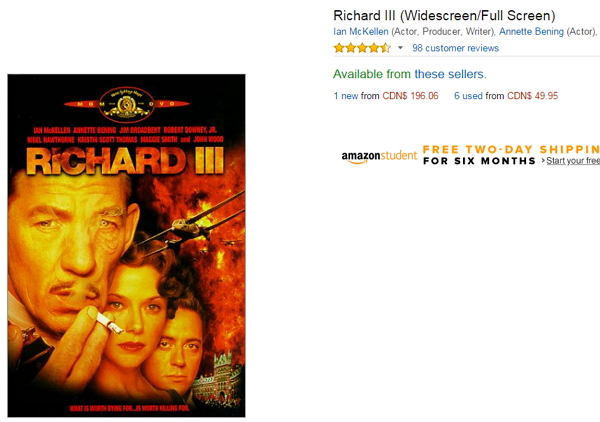
Richard III has been out of print for years. It – like so many movies – has not migrated to Blu-Ray (which increasingly as a format is being primarily used for new releases rather than “archive films”). You cannot stream it on any streaming service. Your only chance of paying even a reasonable price for it is to find a used copy at a decent price, and there are not that many copies floating around.
And Richard III is not an outlier. Consider Big Night, one of the best-reviewed films of 1996 – it’s only twenty years old – and which is now not reasonably affordable. Also from 1996 is Shine, which is far more expensive than it has any right to be considering Geoffrey Rush won his Best Actor award for it. (You can find region-locked DVDs and even Blu-Rays of it for a more reasonable price – if you happen to have an all-region player. But region-locking only contributes to the problem.) There are plenty more of these if you care to look, and I’m only talking right now about relatively high-profile high-regarded films. (If you want a copy of Millionaire Express, Sammo Hung’s classic 1986 kung fu western, you will pay through the nose for it.)
This is the long tail of movie and TV ownership, and it’s coming faster than anybody realizes as movies start going out of print faster than they are introduced to print and the existing stockpile continues to diminish. People in the modern context often question why movies on television were such a thing before the home-theatre revolution, but they were a thing because, for the most part, outside of repertory theatre chains (which have mostly died out at this point), occasional TV screenings were the only way most people could watch many films.
And streaming simply is not catching up. I’m not bashing Netflix particularly here. It’s a good service that offers a good variety of content both original and classic. But you can’t rely on Netflix. Non-exclusive content floats in and out of Netflix on a basis that is nearly whimsical in nature, and Netflix’ profit model means it is not reasonably ever going to have All The Movies or even anything beyond a small fraction of that, and more to the point a lot of Netflix’ catalogue is bottom-dwelling crap that exists primarily to boost its overall catalogue numbers, and Netflix’s catalogue numbers are smaller than most people realize because they are boosted by counting individual TV episodes as individual viewable items. And it skews very, very heavily – for reasons which are quite understandable from a business perspective – towards the recent. Netflix’s “classic” sections are typically very thinly populated. And other streaming services have the same problems. Sure, Hulu has (most of) the Criterion Collection, but get outside of it and pickings get slim for older fare. (I don’t have Amazon streaming, so I don’t know how good that is in this regard.)
The problem – as always – is copyright. Richard III and the like not being easily available on DVD is the result of copyright; its owners have determined that it is not profitable for them to produce copies of the movie for public consumption. (Or, in some cases, have determined that it is more profitable to only allow the movies to be in print/available for streaming on a limited basis – this is the Disney Vault strategy, and Netflix has occasionally advertised films “returning” to Netflix in a way that makes one think that they consider this to be a viable marketing strategy in the streaming era.)
What has happened here is somewhat akin what happens to orphan works. Orphan works exist because their owners die or disappear and cannot exercise their copyrights. In the case of Richard III, what has happened is that an owner is choosing to not produce copies. And this is despite the fact that we live in an era where it is simpler than ever to produce individual copies – digital copies if nothing else. (At my birthday party, Mike Hoye made the point that it is effectively impossible to purchase many books which were bestsellers in the 1940s and 1950s at this point because of copyright, even though we live in a print-on-demand era where purchase of such works should be simpler rather than more complex; I note that this trend is accelerating rather than decelerating.)
All of this is to say that my adoption of Plex is a stopgap solution at best to this problem – because I’m combining it with the purchase of more used DVDs at the same time. Buy the DVD, rip it, put it in the binder, and I have the extra media for minimal expense (both fiscal and storage-wise). But individual ownership of media isn’t an answer to the problem that copyright is causing curation of our culture to be more and more difficult with each passing year, and I’m not sure what the solution is.