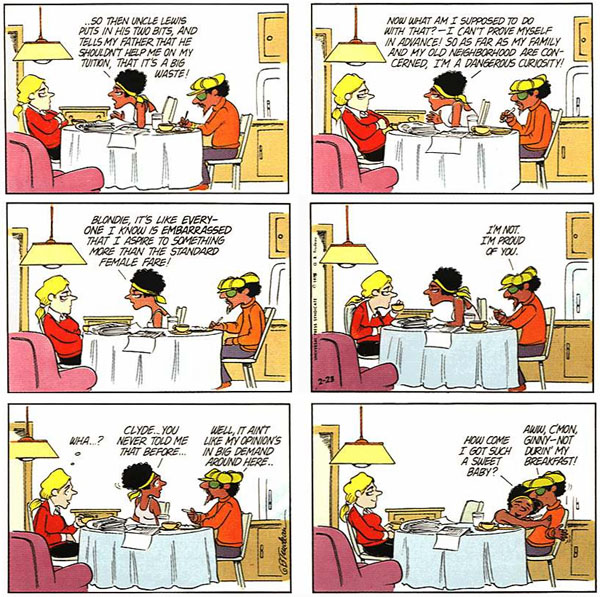
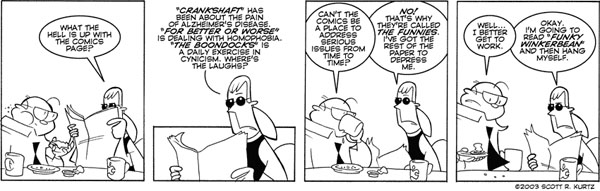
I don’t know if the 80s really were a sort of Golden Age of syndicated comics, or if I’m just remembering the highlights better than the lowlights. But there were some genuinely great strips back then, many of whom made the rare decision to exit the field before they got stale and stagnant. We got ‘Calvin and Hobbes’, ‘Bloom County’, ‘This Modern World’, ‘Dykes to Watch Out For’, we got ‘Dilbert’ (hey, they didn’t all get out before going stale and stagnant…)
And we got ‘The Far Side’.
The wonder and beauty of ‘The Far Side’ is that even though it ended almost twenty years ago, in a way it’s still with us today. Because that was what made it so great; Gary Larson wasn’t just a talented writer and a gifted artist, he had a sensibility that changed the way you look at the world. And that change has been passed on ever since, a meme that has continued to spawn and mutate even though the strip is long gone from the funny pages. Gary Larson didn’t just make perfect, hilariously funny single panel comics day in and day out, he made the world seem like a strange and unusual place. Nobody who’s ever seen a ‘Far Side’ strip can quite think of human history the same way after seeing a picture of two cavemen staring at a dead mastodon, a spear impaled in its side, and saying, “Ooh. We should write that spot down.” (And it’s all part of the peculiar alchemy of his words and his art that the people who’ve never read that strip are saying, “What’s so funny about that?” while the people familiar with it are smiling all over again.)
Larson’s work was an inspiration to a generation of comedians, who went on to found single-panel “quirky” gag strips like ‘Close to Home’, ‘Bizarro’, ‘Ballard Street’, ‘The 5th Wave’, ‘Rhymes With Orange’, ‘In the Bleachers’…good strips in their own right, all clearly bearing the unmistakable stamp of their ancestry. They all work in a world where the strange and unusual is commonplace, where people are slightly eccentric in entertaining ways, and where animals behave like (slightly eccentric) people. They write what they know, and what they know is the world Gary Larson showed them. And even better, Larson’s interest in science, combined with his way of writing about it in an entertaining and humorous way (an amoeba husband hectored by his wife: “Stimulus, response, stimulus, response–don’t you ever THINK?”) inspired a generation of young people to take an interest in anthropology, astrophysics, biology, paleontology (the classic cartoon, featuring a bunch of dinosaurs smoking cigarettes with the caption “What Really Killed the Dinosaurs”) and a host of other fields. ‘The Far Side’ was witty, literate, twisted, and indescribably funny. Every day since Gary Larson brought it into the world is a slightly more amusing, slightly more amazing day. Whether it’s pushing on a door marked ‘PULL’ (“School for the Gifted”) or trying to train your dog and imagining it hearing, “blah blah blah GINGER blah blah blah GINGER”, we’re all of us touched a little bit by Larson’s extraordinary perspective on the world.
Now, may I please be excused? My brain is full.