2

Apr

Movies You Have Not Seen But Should See (Because They Are Good) #17a

Posted by John Seavey  Published in Flicks, Movies You Have Not Seen But Should See

Yes, I know, I’m a guest contributor and I’m totally hijacking one of MGK’s personal topics, but how can I resist the lure of the giant soapbox? It’s a chance to tell large numbers of people to go see a movie I like, and you will all listen to me oh the POWER MUAHAHAHAHAHAHAHAHAHAHAHAHAHAHAHA!!!!!!!!! In case that doesn’t clarify, let me stress again: I’m not MGK. If you have seen this movie, and do not think it is good, don’t blame him for my opinions. Oh, and also, you clearly hate babies and puppies and things that are awesome and are probably a Twilight fan or something.

So, on to Slither. Slither was a 2006 horror-comedy (with the emphasis on horror) written and directed by James Gunn, a horror veteran who got his start writing for Troma Films. His profile had been seriously raised by his screenplay for the Dawn of the Dead remake, and it wasn’t too surprising that he eventually got a shot at directing his own feature. It was, perhaps, a little surprising that he wound up making a film that was such an unabashed throwback to the splatstick horror movies of the early 80s; at the time, horror fans accused him of ripping off Night of the Creeps, but that misses the point. Slither isn’t ripping off any particular 80s horror movie any more than Metallica was ripping off any particular heavy metal band. They just knew they liked the sound and made it their own.

In the same way, Slither takes the tropes of splatstick (physical comedy, combined with grotesque body-horror) and makes them its own. Human beings bloat up like balloons as they gobble down vast quantities of rotting meat, only to be consumed from within by slugs that then jump down people’s throats and burrow into their brains…all so that they can proceed to deliver a speech about marital fidelity in perfect unison. Then spit acid at people. It’s the kind of unabated, disturbing freakishness that requires an R-rating to deliver…and unlike the vast majority of horror films of the last decade, Slither doesn’t water down its horror to cater to a PG-13 audience. This is the kind of movie you used to have to sneak into, back in the day; unfortunately for Slither‘s box office, it’s harder to do that now.

But Slither has more than just gross-out comedy and startle moments going for it; the film has a charming cast of characters that make you genuinely root for them, aided in no small part by the cast. Gunn went for character actors over stars (at this point, I will remind you that there’s an entire comments section in which to debate my labeling of star Nathan Fillion as a “character actor”.) Gregg Henry, one of those quintessential “nobody remembers his name, but everyone remembers his face and performance” actors, makes you delight in every narrow escape of the sleazy mayor as things go from bad to worse (to worse to worse to worst.) And Michael Rooker gives a great performance in a thankless role, taking the thoughtless husband who becomes the host of an alien parasite and making him sympathetic even under a metric fuckton of prosthetics.

But most importantly, Slither is sneakily subversive about the tropes it’s borrowing. Characters constantly behave just a little different than you expect them to in a movie like this; the teenage girl who might as well have Obvious Victim written on her forehead turns out to be a smart, determined survivor, and the brutish heel who’s destined to turn into a monster winds up having a sweet, decent streak in him that you only find out about just before things go bad. The movie’s subversive streak can be summed up in a single scene: One of the characters, having been turned into a breeder for brain-slugs, begs Fillion to kill him. Before you have more than a second to anticipate the traumatic, brutal decision he has to make, Fillion whips out his gun and blows the guy’s brains out. Because jeez, did you see what he looked like?

Unfortunately, Slither bombed at box offices (in no small part because the perfect audience for a splatstick horror movie is sixteen year-old boys, and they’ve cracked down a lot on sneaking into R-rated movies since the golden days of the 80s.) But movies like this are destined to do better as cult DVD hits, building up their reputation through word of mouth and devoted fans. I know I’ve had to practically force a couple of horror fans to sit down and watch it; afterward, one of them said, “Slither is this generation’s Evil Dead II.” High praise, indeed.

And if none of that convinces you, I will say that this movie has the single best karaoke scene ever committed to film. Seriously, I would watch a full 90 minutes of that woman singing karaoke. I’d describe it, but…it has to be seen to be believed. Just like Slither.

28 comments

23

Dec

Movies You May Not Have Seen But Should See (Because They Are Good) #17

Posted by MGK  Published in Flicks, Movies You Have Not Seen But Should See

Christmas movies mostly suck. Miracle on 34th Street gives me hives. It’s A Wonderful Life is a depressing story told the wrong way. About half of the Christmas Carol adaptations completely miss the point (the exceptions: Muppet, Disney, Sim and the recent Zemeckis). Even a A Christmas Story gets more treacly and unbearable every year. (I will admit to a fondness for Love Actually, but what makes the film bearable are the bitter moments where things don’t work out. Plus Rowan Atkinson’s cameos.)

This is because Christmas is equal parts joyful and depressing. The good Christmas movies understand this, which is why most of the good Christmas movies are dark: black comedies about the human spirit’s capability for love even under the most degraded of circumstances, like Bad Santa, or hyperactive Dickens-on-crack stories like Scrooged, and Gremlins, which isn’t really a Christmas movie per se but come on, it’s Gremlins.

“I had this dream -”
“Do we have to do dreams?”
“I’m in this restaurant, and the waiter brings me my entree. It was a salad. It was Lloyd’s head on a plate of spinach with his penis sticking out of his ear. And I said, ‘I didn’t order this.’ And the waiter said, ‘Oh you must try it, it’s a delicacy. But don’t eat the penis, it’s just garnish.’”
“Lloyd, what do you think about the dream?”
“I think she should stop telling it at dinner parties to all our friends.”

But my favorite Christmas movie is far and away The Ref, because The Ref manages to be a very funny Christmas comedy without needing a super-ridiculous dose of silliness or lunacy beyond the everyday mundane madness of human life.

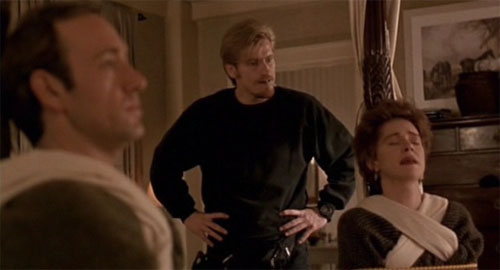
The plot is simple: Judy Davis and Kevin Spacey are married, and they hate each other. But they don’t just hate each other. That would be simplistic. They each hate what they’ve become – a suburbanite couple stuck in Fuckall, Smugachusetts, essentially living off his mother’s largesse – and they’re both depressed as all hell. And there’s nobody else to blame it on except themselves and each other, so naturally, as many couples do in these situations, they’ve opted for both. They’re miserable and planning a divorce.

This is when Denis Leary shows up. At this point in his career, Leary was already starting to transition away from his well-known “asshole” standup persona, most likely because it obviously bored the shit out of him. He goes on a couple of Learyesque rants through the picture because it’s expected, but he’s not playing Denis Leary – he’s inhabiting his character, a tired aging burglar who hates his life nearly as much as Spacey and Davis hate theirs.

“From now on, the only person who gets to yell is me. Why? Because I have a gun. People with guns get to do whatever they want. Married people without guns – for instance, you – do not get to yell. Why? NO GUNS! No guns, no yelling. See? Simple little equation.”

And so, a hostage situation – starting with the married couple, and extending to their son, home from military academy for the holidays – gradually becomes both an extended drier-than-brut-champagne farce as Leary pretends to be a couples counsellor at Davis and Spacey’s family Christmas celebration, and the trigger event for a series of long-overdue bouts of honesty. Ted Demme (who never made another movie as good as this one, although Beautiful Girls came close) builds up tension slowly until Davis and Spacey finally just blow both their stacks and explode at one another in a way you know they never have, and the genius of their respective performances is that you really get that these are two people who really love one another despite everything, and who’ve completely lost how to tell the other that.

But just summing it up like that makes the movie sound boring. And it’s not boring. It’s fucking hilarious. There is an evil dog and a drunk Santa and a useless sidekick and inept small-town deputies. There are more killer performances in this movie than many movies have cast members – not just Davis and Spacey and Leary (every one excellent), but also one of the great Glynis Johns’ last (and most memorable) roles, plus ever-reliables like Christine Baranski and J.K. Simmons. And, as a special bonus, you get to see a great pair of underappreciated character actors – Robert Ridgely, the king of smarm, and Raymond Barry, normally stuck in “military advisor” gigs – use their chops in what’s arguably the best scene of the entire movie.

“That’s not the spirit of Christmas. The spirit of Christmas is either you’re good, or you’re punished and you burn in hell.”

Someone, I forget who, once said that family are the only people who can tear you down and build you up at the same time. This movie’s all about that. Which is why it’s a classic.

23 comments

13

Oct

Movies You May Not Have Seen But Should See (Because They Are Good) #16

Posted by MGK  Published in Flicks, Movies You Have Not Seen But Should See

“Sylvester Stallone in a comedy” should rightly raise warning bells. Warning sirens. Some loud noise of some kind, indicating danger. After all, Stallone’s track record for comedies is dismal, to say the least. (Six words: Stop! Or My Mom Will Shoot!) But every so often, the stars align just so, and what should be a disaster is surprisingly non-disastrous and even pretty entertaining.

This is not to say that Oscar is a perfect comedy. It isn’t. It’s broad. It’s not exactly subtle. And while Sly tries his best (and doesn’t do badly), he’s never going to be Groucho Marx or even Chico, and a comedy like this – a farce, a comedy of errors with a strong emphasis on wordplay – is not really his forte. Plus, there are a couple of supporting performances that just kind of make you wonder things. Like “how did Marisa Tomei ever make it when she started out so poorly?”

“When I took over, your books were a mess.”
“They don’t sound like they’re in no great shape now! …damn, that’s a double negative.”

But it’s just a likable little movie. It has Tim Curry in it, before he was seemingly permanently exiled to play villains for video games, being Tim Curry and therefore completely awesome. It has a great performance from Chazz Palmintieri as a big goon mobster. (I defy anyone to not laugh when Stallone demands he shed all his weapons, and Palmintieri gives sad puppy eyes as he leaves a pile of weapons on a counter, culminating in a spiked ball-and-chain.) It had a whole horde of great character actors at their best: Peter Reigert as a smart-mouthed mobster-turned-butler, William Atherton as a snooty banker, Kurtwood Smith as a moral but not-too-bright cop, Harry Shearer as one half of a pair of quirky Italian tailors, and the late, great Eddie Bracken as a police snitch. It’s got a great cameo by Kirk Douglas and an appearance by Don Ameche in one of his last roles. And it’s got a remarkably clever plot.

“Even in the old days he was known as an honest crook.”
“That’s an oxymoron.”
“Gee, you shouldn’t oughta said that, Doc.”
“Yeah, leave Connie alone. He does the best he can.”

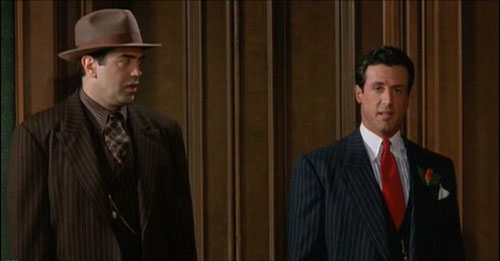
Stallone plays Angelo “Snaps” Provolone, a mobster who promises his dying father he’ll go straight. To this end, he has liquidated his criminal enterprises and plans to buy his way into a bank partnership. However, on the day the papers are to be signed, his young accountant (Vincent Spano, who for a while in the late 80s and early 90s was looking like a big thing, but unfortunately fizzled) comes to him and requests the hand of his daughter in marriage. However, his daughter is in love with the chauffeur, Oscar, and is a bit of a brat who wants to get her way. The cops, suspicious of Snaps’ sudden cessation of criminal activity, are suspicious, and watching his house like hawks. So is a rival gang, looking to muscle in on Snaps (who now appears weak).

“I got it! Your daughter’s not your daughter, and the cash that used to be the jewels is now your underwear!”

And then it all starts to get complex. Because the young accountant hasn’t actually ever met Snaps’ daughter. And things rapidly start to spiral out from one misunderstanding; that’s how a comedy of errors works, see, little things ball up into bigger things and bigger and bigger and then – pow, the payoff. And the good thing about Oscar is that the comedic payoff is an excellent one, all things considered. It’s a fun, hammy comedy, the sort of film Hollywood genuinely doesn’t make anymore because it’s gloriously, unapologetically pre-ironic and we live in a post-ironic world.

Plus, Tim Curry as an elocution teacher. Come on.

12 comments

15

Jun

Movies You Have Not Seen But Should See (Because They Are Good) #15

Posted by MGK  Published in Flicks, Movies You Have Not Seen But Should See

“What’s the most important thing in life?”
“Respect.”
“Too dependent on other people.”
“Love?”
“A little Disneyland, isn’t it?”
“God’s will.”
“Close.”
“What is it then?”
“Necessity.”
“As in?”
“As in people do what is most necessary to them at any given moment.”

The 90s were actually a pretty damn good decade for movies, but even given the richness of the decade there have been any number of overlooked gems. Three Kings is probably the biggest. I went looking for top ten lists of 90s movies and after an hour on Google, Three Kings does not show up on a single one of them. For the sake of comparison, Kingpin shows up twice; Titanic, four times. American Beauty, Sam Mendes’ overwrought and overblown tribute to the spiritual death of suburbia, appears on countless lists of this sort despite it being rather crap. So does Saving Private Ryan, a movie which is technically brilliant at portraying battle but hardly one that says anything especially profound. (“Hey, did you know war is hell? And it’s violent?”) Dances With Wolves makes a lot of lists, and I wouldn’t say that’s a bad movie but it’s not exactly top ten list material, you know? And of course the usual suspects – Goodfellas, Schindler’s List, Unforgiven, Fargo, Pulp Fiction and The Silence of the Lambs – make sure that top ten slots are hotly contested.

Three Kings won no major awards; it made about $60 million at the box office, which was sort of respectable in the break-even sense, but far from noteworthy. It tends to float under the radar, and out of top ten list range – and as time progresses I’m discovering more and more people who haven’t seen it.

“What would you feel if I bombed your wife?”
“Worse than death.”
“Yes, my friend. Worse than death.”

All of that having been said, there is no reason this should be the case. Three Kings is one of the unsung masterworks of the Nineties; morally and ethically complex, and similarly astute without being preachy. The setting (the first Iraq War) is one that hasn’t been overused in the slightest (the only other Gulf War movie I can think of is Courage Under Fire, and that one kind of sucks). The plot (a small group of American soldiers try to steal some of Saddam’s gold and get caught up in the Shi’ite rebellions in the southern tip of Iraq) isn’t cookie-cutter, the cinematography (giving everything a washed-out feel) is bleakly apropos, and the dialogue clever and well-tuned.

“Are we shooting?”
“What?”
“Are we shooting?”
“…are we shooting?”
“That’s what I’m asking you!”
“…what’s the answer?”
“That’s what I’m trying to find out!”

And the performances are uniformly excellent. George Clooney turns in what was one of two game-changing performances for him (the other being Out of Sight) as Archie Gates, a guy who really wants to be an amoral mercenary just this once, but discovers – much to his obvious chagrin – that he just can’t step aside. Mark Wahlberg’s everyman corporal is exactly right, and as his hysteria and exhaustion ramp up through the course of the film you can really get a sense of someone who never had it that easy to begin with finally finding out how desperate life can really get. Ice Cube’s Chief Elgin is Ice Cube being a moral, upright, total badass, which is what Ice Cube does best. And Spike Jonze – who hasn’t acted in a movie since – absolutely steals the fucking movie as the stupidly gentle redneck Private Vig. Jonze is so good it makes you wonder why he doesn’t act more, and the only answer I’ve ever figured that makes sense is that he wanted to try it out and see what acting was like.

“Lord knows what kind of vermin live in the butt of a dune coon.”
“Why do you let this cracker hang around with you, man?”
“He’s all right, man. He’s from a group home in Dallas. He’s got no high school.”
“Don’t tell people that…”
“I don’t care if he’s from Johannesburg. I don’t want to hear “dune coon” or “sand nigger” from him or anybody else.”
“Captain uses those terms.”
“That’s not the point, Conrad. The point is that “towelhead” and “camel jockey” are perfectly good substitutes.”
“Exactly!”

The four soldiers drive the film’s action, but every performance in this film is dead-on. Jamie Kennedy’s dumbass grunt and Nora Dunn’s veteran journalist are both great little performances, and Judy Greer turns in a wonderful little cameo as a slutty TV reporter, but the real meat of the supporting cast comes from two of Hollywood’s go-to Arab-looking guys: Cliff Curtis (who’s actually a New Zealand Maori, but has played so many Arab characters it’s kind of crazy) as the Shi’ite rebel and Said Taghmaoui (a genuine for-real Arabic person, albeit one born in France) as the Iraqi army interrogator. Curtis matches Clooney (one of the truly great movie stars of our time) presence for presence whenever they share the screen; Tahgmaoui’s scene with Wahlberg when the two talk about their respective baby daughters (one living, one not) never lets the viewer go.

“Any questions?”
“Yeah, is it true to be special forces, you gotta cut off an enemy’s ear?”

But what really sets Three Kings isn’t its great performance or story; it’s the fact that this is the rare movie that just about perfectly blends drama and action. Most movies that attempt to combine the two end up being dramas with a soupcon of action (No Country For Old Men) or are action movies that have a stronger than average dramatic core for the genre (Saving Private Ryan). Three Kings, in comparison, shifts gears from action to drama (with occasional sidereels into comedy) repeatedly without ruining the tone or feeling schizophrenic; it does this by diving deeply into the surreality of war and using its weirdness to accomodate everything David O. Russell wanted the movie to do.

“What happened to the Jesus fire, Doc?”
“It’s around you right now, man. It works on this side or the other side.”
“You never told me that part. I guess I could go to one of them shrines that erase the bad you did…”
“We made the right choice today, Conrad.”
“We did good, right?”
“We made the right choice.”

In short, it should be on more top ten lists.

Top comment: Said Taghmaoui is actually Berber, not Arab. – Distantfred

49 comments

5

Aug

Movies You Have Not Seen But You Should See (Because They Are Good) #14

Posted by MGK  Published in Flicks, Movies You Have Not Seen But Should See

Comedies, as a rule, do not age well. Good comedies are plagarized endlessly until nobody laughs at the gags because they’ve already seen them on The Simpsons, and if not, simply become dated as senses of humour shift. Bad comedies are just bad and remain bad. It takes a truly timeless comedy to remain funny decades later – A Night At The Opera, Some Like It Hot, A Shot In The Dark, Animal House – and they are few and far between.

However, comedies, over time, can transform. The Apartment, for example, hasn’t aged particularly well in terms of its humour, but its romantic aspect is strong enough that now it works better as a lighthearted, clever romance (as opposed to a laugher with a romantic plot). For most comedies, this is the eventual goal: redefinition into another genre or success on grounds other than the pure hilarity they can’t, for whatever reason, manage.

The Man In The White Suit, made in 1951, is an excellent example of a comedy redefining itself as time passes. Modern audiences, honestly, won’t find it particularly funny – but it’s smart, and engaging, and clever.

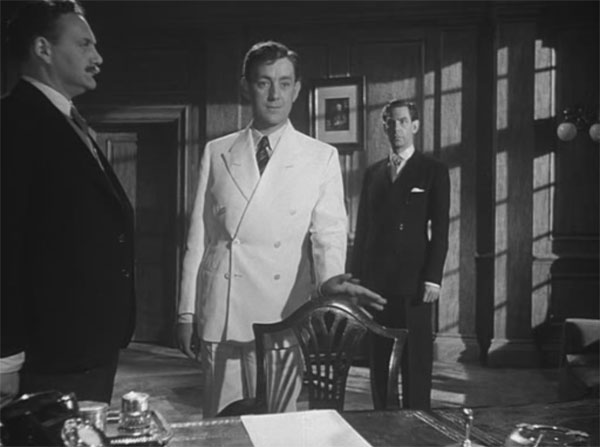
The story of the film is that of an inventor named Sidney Stratton, played by Alec Guiness (yes, that Alec Guiness – he started out as a comedic lead). Sidney is obsessed with a mysterious discovery, so much so that his demeanour at times becomes almost sinister as he pursues his goal. Eventually we learn that Sidney’s plan is to invent a superstrong fabric that never wears out and repels dirt. And one day, he finally does it – and promptly has a white suit (he can’t figure out how to make the fabric hold dye) made from the fabric. (Which he has to cut with a blowtorch.)

All of this would prove decent enough comic fodder, but the reason The Man In The White Suit works is because everybody in the movie except for Sidney has an admirable degree of common sense as regards their own livelihoods. The textile mill owners want Sidney’s invention suppressed because they can’t make enough money off suits that never wear out. The textile mill workers want Sidney’s invention suppressed because they realize once everybody has enough clothes made from the new fabric, they’ll all be out of work. (This actually leads to one of the best plot developments in the movie, as Sidney desperately manages to escape from the owners holding him hostage only to be caught by the workers, who think the owners are going to screw them – until everybody realizes what page everybody else is on.)

Guiness plays Sidney perfectly, a near-Aspergin’ level of obsession and lack of social experience without any hint of malice or bad manners; for most of the movie Sidney honestly hasn’t any idea why everybody is so panicked about his invention. He’s focused on the big picture: when everybody has indestructible clothes, Life Will Be Better. And in the long run he’s right, of course, but nobody is going to be comforted by the long run and he can’t understand that, and Guiness brilliantly makes it obvious that his lack of understanding has nothing to do with arrogance or stupidity but simple innocence.

So thus we have a movie, originally a comedy, but now far more of a low-tech sci-fi movie, or alternately a parable about progress and science; it works on both levels. The performances remain intelligent and nuanced, the story remains engaging. It’s just not as funny as people once found it, and the ending doesn’t quite match the tone a modern viewer will find in it (although it’s not completely off, either). But that doesn’t mean it’s not still relevant, in its way.

10 comments

14

Jul

Movies You Have Not Seen But You Should See (Because They Are Good) #13

Posted by MGK  Published in Flicks, Movies You Have Not Seen But Should See

One thing movies tend to do for the most part really badly is portray realistic geniuses. I mean geniuses, not just smart people. The people whose brains run on different tracks. Almost uniformly these characters get slotted into two tracks: the comic relief nerd (Egon in Ghostbusters) or the crazy savant (for example, the horrifically bad A Beautiful Mind). Worst of all is the tortured genius genre, wherein the filmmakers take pains to make sure we all understand how tortured the genius in question is, merely because he’s a genius. How persecuted a genius must be!

Zero Effect is that rare accomplishment: a movie about a tortured genius that avoids cliche, easy answers, and mawkish sentimentalism. It’s also very entertaining on a quiet, subtle scale; the dialogue crackles and the plot is brilliant. It also manages to portray the fact of being a genius in an original, compelling way.

Darryl Zero (Bill Pullman) is the aforementioned genius – the “world’s greatest private detective,” but for real. He apes certain trappings of Sherlock Holmes (naming his cases with ostentatious names like The Case Of The Man With The Nonexistent Suitcases), but he’s also an emotional wreck – agoraphobic, obsessive-compulsive and with social skills that are poor. But – and this is wonderful – over the course of the movie it becomes apparent that he is these things not because he is a genius, but because like everyone else on the planet, he is fucked up in his own way.

A “before he got real famous and annoying”-era Ben Stiller plays Zero’s Archie Goodwin analogue, Steve Arlo. Steve hates his job, but remains loyal to his boss even as he realizes he has to quit, and assists Zero in handling the case. It’s a good dramatic performance by Stiller, who can actually act when he wants to do that. (Which, because he is rich thanks to mugging like a jackass, is not often. But frankly, if I were rich thanks to mugging like a jackass, I would do the same thing.)

Arlo, on behalf of Zero, is contacted by a rich man named Stark (Ryan O’Neal at his sleazy best). Stark is being blackmailed, and wants the blackmailer found. That’s the mystery, and it absolutely ruins the movie if I tell you how Zero solves it or how it plays out – but I assure you, the payoff is excellent and the process utterly engaging.

But this isn’t just a mystery; it’s also a story about a guy who is fucked up trying to unfuck himself a little. Zero begins this process when, in the course of his investigation, he meets Gloria (the superlative Kim Dickens, who went on to play the magnificent Joanie Stubbs in Deadwood and nowadays occasionally shows up as the mother of Sawyer’s kid in Lost), an enigmatic EMT with obvious smarts. It spoils nothing to say that Gloria ends up being involved in the mystery to an extent (I mean, come on), but how she is involved and the ramifications of her interactions with Zero are fascinating to watch.

This is a difficult post to write because the process of watching this movie is half the fun; it’s just well-written on a scale that’s amazing, every performance is just about perfect and the direction by Jake Kasdan is competent enough to know not to get in the way. As I write this, I want to explain how the follow-the-money sequence brilliantly shows, rather than tells, how great a genius Darryl Zero is (and does so with a narrative voiceover, normally the bane of evocative filmmaking). But if I did, that would ruin it.

So you’ll just have to trust me on this one.

13 comments

28

May

Movies You Have Not Seen But You Should See (Because They Are Good) #12

Posted by MGK  Published in Flicks, Movies You Have Not Seen But Should See

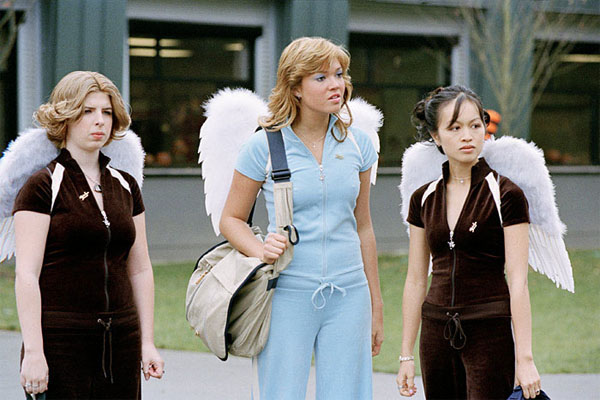
Another film that got overlooked in theatres, and although most who have seen it sing its praises (and given the subject matter that is kind of a bad pun), it still hasn’t found the audience it rightly deserves on DVD as of yet. Right now it’s mostly a cult flick.

Saved is an excellent film about the troubling and fascinating power of faith, which takes very little for granted. As such, predictably, conservative Christian movie review sites hate it. The movie is a liberal one, but it is most certainly not an antireligious film; its conclusion lies firmly in the pro-faith side of the argument. I personally think this is part of the reason it fell under the radar – its target audience of tolerant faithful, while much larger than anybody gives it credit for, is not nearly so outspoken as the conservative religious and liberal non-religious camps.

It’s a movie with a number of nuanced performances, all uniformly excellent. Mandy Moore started off her penchant for playing hilarious psycho bitches with this movie. Her Hilary Faye is a terrific villain, but not unsympathetic – her nervousness and obvious lack of self-generated self-esteem turn what could have been a total cariacature into a compelling downward spiral. She might be bad, but she’s never one-note and she’s always understandable.

Jena “was Ellen Page before Ellen Page was Ellen Page” Malone plays the lead – a devout girl who becomes pregnant as a result of trying to “cure” her gay boyfriend’s homosexuality. She’s excellent – watching her faith shatter, then reform on her own terms is fascinating. When she hits bottom and stares at a church and just starts swearing, daring God to strike her down for blasphemy, it’s both sad and at the same time slightly funny. She’s not any good at blasphemy, so she just utters a few basic swear words like they’re the text of the Necronomicon, but Malone makes it work and then some. You can feel her devastation thoroughly.

The rest of the cast are uniformly terrific. Macaulay Culkin – of all people – contributes a gentle, understated and clever performance as Hilary Faye’s crippled brother. Patrick Fugit (who, I am informed by girls I have seen this movie with, has grown up all dreamy-like since Almost Famous) plays Malone’s love interest, a returning missionary who rides a moped. Heather Matarazzo (Welcome to the Dollhouse) contributes a brief turn as Hilary Faye’s lackey. Martin Donovan’s conflicted Father Ted is well done, and Mary-Louise Parker (whom I will watch in anything) is fantastic as Malone’s mother.

It’s a damned good movie, and a reclamation of religious faith for liberal values; the two are not incompatible and anyone who says different is simply wrong. And it’s funny. Especially when Mandy Moore runs Jesus over.

33 comments

22

Apr

Movies You Have Not Seen But You Should See (Because They Are Good) #11

Posted by MGK  Published in Flicks, Movies You Have Not Seen But Should See

When 24 first debuted, everybody was making a huge deal about it being a story told in real time (well, except for Keifer Sutherland never having to go to the bathroom or anything like that), because it was, in fairness, something of a novelty.

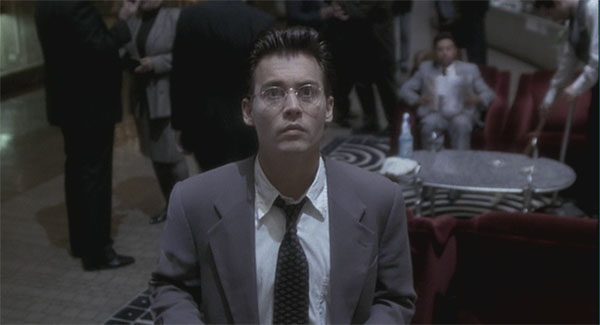
Mostly because nobody had seen Nick of Time. It absolutely bombed in theatres and didn’t do much better on home video, which is a shame because it’s a really good little thriller which nowadays should be something that gets more notoriety, seeing as how it stars Johnny Depp at a point after Depp was a name but slightly before Depp became a bona fide leading man for action movies.

And it has Christopher Walken as the crazy-ass bad guy. This is good Walken, the sort of Walken role where in addition to being some variety of kooky there’s also weight to the role. All too frequently, Walken’s oft-stated tendency to take absolutely any script that comes his way in order for the paycheque comes to the fore: consider Balls of Fury, Domino, Click, or Man of the Year (and that’s just the lowlights of the last three years). However, every so often Walken gets to be in a decent movie where he can be heartwarmingly off-kilter (Hairspray, Catch Me If You Can) or freaky and otherworldly (The Prophecy, Sleepy Hollow), or, at best, terrifyingly and criminally strange (True Romance, Things To Do In Denver When You’re Dead).

In Nick of Time, Walken gets to be a completely amoral mercenary who likes to tell stories. I am sure your appetite is now whetted.

The plot of Nick of Time is quite simple, if contrived: Walken, representative of a shadowy conspiracy, selects Depp at the train station when he sees Depp with his young daughter to kill the Governor of California (a totally awesome Marsha Mason). Walken and his partner (played with equal badassedness by Roma Maffia) take the girl hostage. If, in ninety minutes, the Governor isn’t dead (with the gun they give him), they kill his daughter.

It’s a ridiculous premise, of course, but director John Badham (who these days, after having directed classics like Saturday Night Fever and WarGames, is apparently just directing episodes of second-tier television programs, sad to say) plays it absolutely straight and never lets the viewer lose suspension of disbelief – making sure that clocks are near-constantly in frame to remind the audience that time is ticking away (and the fact that the movie is in real time just reinforces the tension), regularly framing the action through video cameras (held by operatives of the shadowy conspiracy, who plan to use the tape of Depp running around looking frantic and nervous as proof that he was clearly a crazed assassin), and using the narrow halls of the hotel where practically the entire film takes place as befits the paranoid feeling of the film.

The dialogue between Depp and Walken crackles; Depp plays desperate straight man to Walken’s crazy rant master. And although the plot is ludicrous, the payoff at the end is tight with not an ounce of narrative flab. Plus, you get to cheer for Charles S. Dutton, and who wouldn’t want to cheer for Roc?

10 comments

25

Mar

Movies You Have Not Seen But You Should See (Because They Are Good) #10

Posted by MGK  Published in Flicks, Movies You Have Not Seen But Should See

At one point, a long time ago, Dabney Coleman was the king shit.

You have to understand that at this time, Dabney Coleman was the definition of irascible authority figure. If you needed a tough bastard who deep down (often very very deep down) had a heart of gold, Dabney Coleman was your first and only choice. (Well, unless Howard Hesseman was available, but let’s face it, Howard Hesseman carries with him a streak of anti-authoritarianism that sometimes fails to work in establishment roles.)

But sometimes, you gotta stretch a bit.

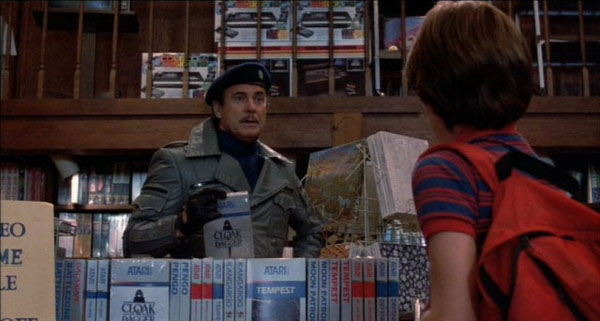
Cloak and Dagger is perhaps one of the biggest stretches of all time in another sense, seeing as how it is loosely – very, very loosely – themed around the Atari arcade game of the same name. You might be thinking that making a movie after a popular game is no big deal, what with this being the era of Doom and Resident Evil and presumably other video game movies, possibly some of which don’t even have zombies in them. However, again, I feel the need to stress that this was an Atari video game, and it’s not like they made a movie out of Asteroids or Donkey Kong.

Wait, they made Super Mario Brothers, and that’s kind of like a Donkey Kong movie. I retract my previous statement.

Regardless. Considering that the Cloak and Dagger videogame did not, as such, have a plot, the screenwriters basically went apeshit and put the actual video game in the movie as a plot element, using it to smuggle important spy document sorts of things. Henry Thomas (Elliot in E.T.) stars as the kid hero who daydreams of being a super-spy, adventuring alongside his hero, super-spy (and star of both roleplaying game and video game) Jack Flack. And of course, his ludicrous adventures turn awry when he actually stumbles upon a real spy conspiracy – and of course nobody believes him.

And Coleman – Coleman plays a double role, and it’s a brilliant turn – as both the boy’s father and as his fantasy of Jack Flack. The two roles play off each other perfectly, the sober responsibility of the father contrasting in just about every way with Ideal Boyhood Companion (and pretty much insane) Flack; Coleman switches roles easily and smoothly, never letting Flack and Dad coincide, even for a moment – which works out perfectly when Flack turns out to be, unsurprisingly, pretty much useless for anything serious and Dad has to go full-on enraged papa bear to save his son from the actual real terrorists.

It’s an excellent family movie, and one of the few good family-appropriate thrillers extant period. (It’s not exactly a genre that gets a lot of play, after all.) It’s exciting on its own merits, frequently a little bit scary (and I am a firm believer that there is nothing wrong with family movies being a bit scary). And it has Dabney Coleman in it. What more could you ask?

17 comments

20

Feb

Movies You Have Not Seen But You Should See (Because They Are Good) #8 and 9

Posted by MGK  Published in Flicks, Movies You Have Not Seen But Should See

Sherlock Holmes does not get enough movie love, these days.

I’m not sure when it happened, but at some point Sherlock Holmes, one of the most fantastically cinematic characters there is, got relegated to television. The lengthy Jeremy Brett series The Adventures of Sherlock Holmes likely had something to do with it, simply because it was such a good television show and so perfectly realized that it almost seemed to make further adaptations of the classic Holmes stories pointless. (After all, the series managed to neatly adapt practically all of the original Holmes stories.)

There’s also the continuing fear of making new Holmes stories, not least because the original Sherlock Holmes stories are so elegantly written; the mystery genre is, to this day, largely defined by the rules set out by Sir Arthur Conan Doyle, even if he never actually intended to create rules for mystery writing in the first place. And if you’re going to write a mystery story, it becomes more intimidating to write one using Sherlock Holmes, because his fanbase, to this day, remains quite enthusiastic – and judgemental.

Even so, that’s no excuse. More Holmes movies are needed. But, in the meantime, there are two excellent and largely underrated flicks for Holmes fans to enjoy, both evading the “but I can’t imitate Conan Doyle” trap by twisting the concept as they saw fit to create a new type of story.

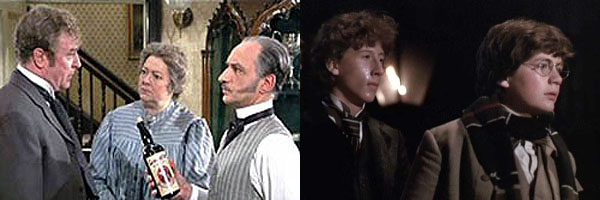
Without A Clue goes for a comedic take on the Holmes saga, with a very simple premise: Watson is the actual genius. The film actually mirrors a lot of real-life publisher’s intrigue surrounding Holmes: Conan Doyle based the Sherlock Holmes character on a police physician (Dr. Joseph Bell – there’s actually a very good BBC mystery series called Murder Rooms about Bell solving mysteries, with Conan Doyle in the Watson role). Further, Conan Doyle, like Watson in this movie, grew heartily sick of Sherlock Holmes and tried to get rid of him.Of course, Conan Doyle just tried to kill him off in a story. Watson (played by Ben Kingsley, who is awesome in just about everything he has ever been in) has a more difficult trick: due to originally wanting to solve the mysteries incognito (which he’s gotten past, not least because he’s realized how lucrative the private detecting business can be), he hired a drunken stage actor named Reginald Kincaid (Michael Caine, who is, as always, Michael fucking Caine) to play the Holmes role. Finally, Watson loses his temper and fires Kincaid, but – whoops – nobody wants to read about “John Watson – the Crime Doctor!” So he reluctantly rehires Kincaid for one last go-around, and of course this turns into a fantastic adventure.

It’s hilarious and exciting both, in equal measures (the final action sequence, in a burning theatre, is really fantastic considering it’s a couple of British guys in their 50s doing all the stunt work), and although the film suffers part way through for having Kingsley offscreen for an extended period (and it’s a shame, because when Caine and Kingsley are tossing lines at one another like exploding popcorn, it’s almost unparalleled great fun), when he storms back triumphantly it’s just all the better. And Caine is of course himself in full fetter, playing the type of role he plays best – a working-class lad trying to pretend he’s classier than he is. As a bonus, Jeffrey Jones plays Lestrade, and Jeffrey Jones is hilarious in everything.

Young Sherlock Holmes goes a wholly different way, one that was somewhat controversial among Holmes fans – it’s a swashbuckling adventure flick rather than a pure mystery, and Holmes’ detective skills, while evident, aren’t nearly so important to the story as his ability with a rapier. Answering the never-asked-but-why-not question of “what if Holmes and Watson met when they were in school” with “well, clearly they would investigate a murderous cult,” the film is nowadays frequently reduced to being the answer to a trivia question. (“What film had the first totally computer-generated character?”)

It deserves better. Young Sherlock Holmes is burdened unfairly in a number of ways, not least being the fact that the bad guys are a cult (one of those things that never really seems to click with audiences in movies). Alan Cox as Young Watson is, perhaps, somewhat overwhelmed by the role. And maybe a little more detectoring would have been in order, considering it’s a Sherlock Holmes movie in title if nothing else. (Admittedly, the film’s ending makes it clear that Holmes’ experiences over the course of the story teach him to value deductive logic and discipline above all else, so it’s not incorrectly used – but it still feels a bit incongruous.)

But its strengths greatly outweigh the minuses. The action sequences are excellent, the plot well-thought-out (it was written by Chris Columbus, of all people). The villains are excellent and genuinely freakish when they need to be, and the hallucinogenic sequences are scary in all the right ways. The comedic bits don’t detract from the story in the slightest (and in a movie like this one, where the desire to break the fourth wall is almost palpable, that’s a great thing). Best of all, the central romantic relationship between Nicholas Rowe’s Holmes and Sophie Ward as Elizabeth is excellent; both young actors are very talented and play their roles near-perfectly.

Both films are great, but they can’t give us what we truly crave, which is more original Holmes flicks in the classic mold. But, until such time as somebody makes a new one, they do quite nicely.

19 comments

30

Jan

Movies You Have Not Seen But You Should See (Because They Are Good) #7

Posted by MGK  Published in Flicks, Movies You Have Not Seen But Should See

Beautiful Girls is something of a rarity, because it is a guy movie.

By this, I do not mean it is an action movie, which for some reason has become the accepted definition of “guy movie,” despite the fact that women can enjoy a good action movie just as well as men can. (Men, to be fair, are probably better at enjoying shitty action movies. Eighteen million opening gross for Rambo, baby!) It doesn’t mean “stupid gross-out comedy” either – thankfully, society’s notions of gender have evolved to the point where a boy fucking a pie is considered hilarious entertainment for both sexes, and honestly, aren’t we all slightly better for that?

No, Beautiful Girls (a great film in the fine and too-short career of the late Ted Demme) is a guy movie in that it is the equivalent of a “bonding”-style chick flick, except instead of being about women, it is about men. This is a dreadfully rare commodity in Hollywood; Diner and About A Boy are probably the only other two major entrants in the field, and the latter is also about single parenting and the definition of family, so let’s say it only counts as half. The simple truth is that, at some point, Hollywood decided – and probably not entirely without justification – that movies about men confronting their fears and anxieties, men bullshitting, and men being, well, guys, were not box office mojo in the working. So this is a rare example of it.

And it’s a good example, of men supposedly in their prime, their early thirties – and societally, we’re all conditioned to accept that men in their early thirties to mid-forties are expected to take the lead in any problematic situations, there has been science done on this and everything, trust me – and, like most men in their early thirties, not really happy about it. In your early thirties, you’re not definitively not a kid any more, you’re an adult – but oftentimes, you still don’t know what you’re doing with your life, where you’re going; and if you’re very, very lucky, maybe you understand women a bit.

Willie (Timothy Hutton), a piano player, comes home early to his small hometown for his high school reunion, his girlfriend (Annabeth Gish) due to arrive a couple of days later. His brother Mo (Noah Emmerich) is (mostly) happily married. His best friend Tommy (Matt Dillon) plows snow and landscapes for a living, and relives his high school football glory days by cheating on his girlfriend (Mira Sorvino) with his former head cheerleader (Lauren Holly). Paul (Michael Rapaport) is trying to fix his relationship with Jan (Martha Plimpton).

Floating around these guys are Max Perlich as “the sidekick,” Pruitt Taylor Vince as “the other friend done good,” Uma Thurman as “the unattainable dream girl,” and Rosie O’Donnell as, well, mostly herself really, but this was long before she got annoying, back when she still did excellent standup. All of these performances are excellent; Emmerich allows his calm, placid demeanour to occasionally reflect the anxiety every dad who doesn’t understand why he’s a dad already, Holly’s brittle exterior lets us see her need to not just become another suburban wife, and Hutton’s everyman character is universal without being generic.

And then, on a whole other level, there is Natalie Portman, playing an intelligent, nigh-luminous thirteen-year-old girl named Marty, who immediately develops a deep (but, do not worry, PG-rated) relationship with Willie. The script and Portman’s performance play this absolutely right; Willie laments (and you can understand why) that he’s actually jealous of some punk 13-year-old kid because that kid gets to be thirteen at the same time as Marty – and it’s obvious that Marty is equally jealous of Willie’s girlfriend for exactly the same reason in reverse. Every time Portman is on screen, the sense that there’s this amazing life ahead of Marty is strong without ever being forced or obvious. This could have been a plotline that wrecked this movie, simply because the temptation to eroticize it for shock value would be obvious, but it’s played respectfully and intelligently throughout – although Willie and Marty both wish things were different, they just aren’t. And they have to deal with that.

This is a movie about guys being guys. About guys playing video games (and cheating when their friend’s back is turned), about guys getting drunk and having a singalong, about guys stupidly not understanding that they have a good thing going with a given girl, about guys not understanding when they’ve fucked up a thing with a given girl for good, about guys swearing at each other, about guys having a tendency to want to fight things out to solve them even when they know it’s stupid and won’t help, about guys thinking with their dick and about guys managing to not think with their dick, about guys wanting to live the dream and about guys learning to settle for a pretty good thing instead. And you should see it. Because it’s pretty damn good.

12 comments

30

Oct

Movies You May Not Have Seen But Should See (Because They Are Good) #6

Posted by MGK  Published in Flicks, Movies You Have Not Seen But Should See

The Frighteners. Six years or so ago, it was slightly more obscure, but those movies with the hobbits in them mean that Peter Jackson’s earlier movies have received more attention. Of course, most of that attention went to Heavenly Creatures, which is excellent and deserves it and that’s all right, but The Frighteners is a pretty goddamned solid movie in its own right, and just right for Halloween viewing (hence this post, you see).

In its way, The Frighteners is delightful. Yes, it’s a bit uneven, starting out as an off-kilter supernatural comedy then shifting to a horror flick and finally culminating in balls-out sci-fantasy action. But it’s good comedy followed by good horror followed by good action, so if it’s uneven in tone it never really varies in quality, and the special effects are just choice to boot, the entire way through.

This is one of Michael J. Fox’s last onscreen film roles before he permanently migrated to television and the occasional voice-acting job, and it’s worth noting just how fucking good an actor Fox is, not just as a comedian (and during the funny parts of this movie, his timing remains as choice as ever), but as a dramatic actor too and even as a believable action star in the “normal guy forced to crank it up” ouevre of action. Fox just has chops a mile deep. It’s uncanny how talented he was in his prime, and a further reminder of how much Parkinson’s Disease really goddamn sucks ass.

Fox of course completely commits to the role of Frank Bannister, a man with deep emotional scars who can see the dead (and uses it for personal gain in the least satisfying of ways). But he’s matched by a cast that commits to their roles in turn. Trini Alvarado, whose career never really took off – and that’s a shame, because she pairs up Andie McDowell-esque looks with the actual acting talent Andie McDowell never had – works the love-interest/co-hero mode excellently, and her contributions to the final fight scene are wholly exciting. Chi McBride shows up (really, once I type the words “Chi McBride” you know at least part of whatever I’m talking about will be good) along with John Astin as an elderly ghost, and I am not quite sure how that works particularly. (Along with a lot of the other elements in this movie – The Frighteners is a movie that requires wholesale commitment from the viewer and a willingness to think things like “well, ghosts, that’s why” a lot.) Jake Busey’s crazy-ass baddie is just fantastic – utterly psychotic and well worthy of his eventual ghostly asskicking – and yes, he really is the spitting image of his dad, and all the moreso in this flick. And Jeffrey Combs’ crazy-ass FBI agent (there is a lot of crazy in this movie, but it mostly works because a movie that is about people who deal with ghosts should be weird as all get out) is hilarious.

And, again, it’s Peter Jackson, and that means one thing: inventive visual genius married to an action sense that equals top-notch entertainment for all concerned. Well, not all, maybe, because this is a movie where a guy’s head explodes and rotting things fall apart at times. But if you like that, or at least can get past it, then by all means, catch this.

P.S. Go with the director’s cut, which adds both fifteen extra minutes and 150 percent better flow in the action sequences. Trust me on this one: Peter Jackson films are always more coherent in the director’s edits.

13 comments

16

Oct

Movies You Have Not Seen That You Should See (Because They Are Good) – #5

Posted by MGK  Published in Flicks, Movies You Have Not Seen But Should See

I have taken, in my time, a lot of grief for unapologetically loving Posse. I am not sure as to why.

It certainly can’t be because the movie isn’t entertaining. With a wealth of excellent performances from Mario Van Peebles, Big Daddy Kane, Tiny Lister, Billy Zane (as the crazy evil white dude) and Stephen Baldwin (as the crazy good white dude) and many others – including the usual Peebles brigade of former blaxploitation stars, this time around casting Pam Grier, Isaac Hayes and Peebles’ father Melvin – the acting in this Western is definitely up to snuff. (Amusing: current Black Panther writer Reginald Hudlin shows up as an extra.) The action sequences are excellent (as can be expected from Peebles’s direction), and the plot is perfectly decent. Okay, maybe the bits with the golden bullets are a touch melodramatic, but they also add a pleasant larger-than-life, mythic aspect to the movie.

Plus – and this cannot be underrated – the movie addresses a major complaint I have with Westerns, which is to say their whiteness. There were a lot of black people headed west during the post-Civil-War period, but in just about every Western movie you find a dearth of black people – short of Morgan Freeman’s turn in Unforgiven I’m hard-pressed to think of any offhand. This sort of thing is forgivable in earlier westerns like High Noon, but it’s something that continued way longer than it should have; even when movies like Silverado and Tombstone had token Mexicans (mostly because sloppy-looking banditos in sombreros with guns are a staple of the Western, for good or ill), there was always a conspicuous lack of black people. And that is lame.

Some have criticized Posse for being an overreaction to this, in the “oh so you’re not going to have black people in your Westerns well I’ll make a Western with all black people, how do you like them apples” variety. They have a tiny bit of a point, but given the cinematic situation with westerns and blacks, it’s not a very big point, and moreover it’s just plain harping considering that Posse isn’t just cinematic affirmative action but a damned entertaining movie in its own right. When Stephen Baldwin’s crazy white boy points out, quite reasonably, that “I ain’t ever personally enslaved nobody,” Peebles gives him ups that the argument doesn’t necessarily even deserve. That’s because Peebles, in addition to writing a damn fine oater, also wants to be fairminded.

But so what if he is? This is a movie with black cowboys quoting poetry and Scripture while they shoot the bad guys, with Stephen Baldwin throwing knives at people (this long predates Stephen Baldwin’s born-again phase, for those wondering), and Billy Zane wearing an eyepatch because he is EEEEEEVIL. It is good goddamned fun. I can understand not liking Westerns as a genre, because not everybody likes cowboys. But if you do like Westerns, why you would not like Posse is beyond me.

12 comments

10

Oct

Movies You Have Not Seen That You Should See (Because They Are Good) – #4

Posted by MGK  Published in Flicks, Movies You Have Not Seen But Should See

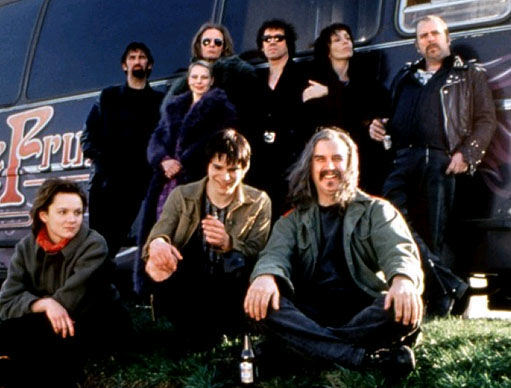
Brain Donors is one of those movies that I routinely inflict upon my friends. Unlike other overlooked movies I have previously mentioned, Brain Donors is not necessarily a movie everybody will love. Because Brain Donors can be explained in one simple sentence: it is a remake of a Marx Brothers movie with a young John Turturro in the Groucho Marx role.

“No?” Flakfizer doesn’t know the MEANING of the word “No!” We’re also a little fuzzy on “panaglutin” and “viscosity.”
 
Actually, come to think, everybody should love Brain Donors precisely because it is a remake of a Marx Brothers movie (specifically A Night At The Opera, their finest, except with ballet instead of opera) with John Turturro in the Groucho role. And let me assure you that Turturro is full-on manic in what I consider to be his finest pure comedic performance ever. Yes, better than any Coen brothers film he’s ever been in. Yes, better than his freak turn in Transformers, where he was the best thing about a pretty marginal movie. As Roland T. Flakfizer (Brain Donors enthusiastically embraces the silly-name traditions of the Marxes), Turturro chews up the scenery then regurgitates it as cud to digest later.
“Charity work. I gather these for those less fortunate than myself who can’t afford pornography.”
 
Still, the Groucho role is only one of three in a Marx flick, and luckily Turturro has compatriots as game as he is: Bob Nelson, a more-or-less unknown standup comedian, takes on the Harpo role with exceptional gameness (and turns out to be a splendid physical comedian), and Mel Smith turns the Chico role from Italian-American to illegal-British-immigrant, matching Turturro word-for-word in often-dizzying dialogue.
“I could make love to you right here.”
“Roland, let’s keep this professional!”
“Fine, I’ll charge you fifty bucks a pop.”
 
Brain Donors is old-school, a finely-tuned romp with an enthusiastic love of silliness for silliness’ sake. Every single element of this movie is dialed up to eleven (except for Turturro’s performance, which I would estimate to be dialed up to around thirty-six). And the best thing is that it builds, and builds, and builds, starting with Turturro chasing an ambulance (literally) and slapping an inflatable rotator cuff on an opportunistic little kid while encouraging said kid to sue his parents (“I sued mine!”), and ending with one of the funniest extended sequences in film comedy ever, a twenty-minute sequence with the three numbskull-heroes deliberately sabotaging a performance of Swan Lake so that the evil ballet dancer (yes, there’s an evil ballet dancer) and the evil rich guy get their horrible comeuppances.
“And that spells cash with a capital…”
“K!”
“You should go back to school.”
“I hated teaching.”
 
I won’t pretend that Brain Donors is going to be everybody’s cup of tea; even a modernized take on the Marx Brothers isn’t going to appeal to everybody no matter how much I think it should. But it has John Turturro shooting at a large man in a duck costume onstage in the middle of a ballet, and if loving that is wrong then I don’t want to be right.

14 comments

Subscribe in a reader

"By MightyGodKing, we mean sexiest blog in western civilization."
-- Jenn

Contact

mgk@mightygodking.com

MGKontributors


  • Andrew Foley
  • Dan Solomon
  • Elizabeth Graham
  • Jaime Weinman
  • Justin Zyduck
  • Karen Whaley
  • Matthew Johnson
  • Will Entrekin
  • Wendy White

MGKlassics

  • A Handy Introduction (Read This First!)
  • And Who Is This Handsome Devil?
  • I Don’t Need Your Civil War
  • I Should Write The Legion
  • Same Old, Same Old: Teen Titans #44
  • So you don’t have to read it: Harry Potter and the Deathly Hallows
  • Very Naughty Edition: Ultimate Power #2

The Big Board


  • Bad Comedy
  • Books
  • Comics
  • David Suzuki Says You're Bad
  • Flicks
  • Gaming
  • I Should Write Dr. Strange
  • I Should Write The Legion
  • Intellectual Property
  • It's The Youtube
  • Law
  • Muzak
  • Nothing Else Fit
  • Num Num Num Num Num
  • Photoshopp'd
  • Politics
  • The Internets
  • The Miscellaneous Sciences And Crap Like That
  • TV
  • Writering
  • WTF

Blogroll

  • ‘Aqoul
  • 4th Letter
  • Andrew Wheeler
  • Balloon Juice
  • Basic Instructions
  • Blog@Newsarama
  • Cat and Girl
  • Chris Butcher
  • Colby File
  • Comics Should Be Good!
  • Creekside
  • Dave’s Long Box
  • Dead Things On Sticks
  • Digby
  • Enjoy Every Sandwich
  • Ezra Klein
  • Fafblog
  • Galloping Beaver
  • Garth Turner
  • House To Astonish
  • Howling Curmudgeons
  • James Berardinelli
  • John Seavey
  • Journalista
  • Kash Mansori
  • Ken Levine
  • Kevin Church
  • Kevin Drum
  • Kung Fu Monkey
  • Lawyers, Guns and Money
  • Leonard Pierce
  • Little Dee
  • Mark Kleiman
  • Marmaduke Explained
  • My Blahg
  • Nobody Scores!
  • Norman Wilner
  • Nunc Scio
  • Obsidian Wings
  • Occasional Superheroine
  • Pajiba!
  • Paul Wells
  • Penny Arcade
  • Perry Bible Fellowship
  • Plastikgyrl
  • POGGE
  • Progressive Ruin
  • sayitwithpie
  • scans_daily
  • Scary-Go-Round
  • Scott Tribe
  • Tangible.ca
  • The Big Picture
  • The Bloggess
  • The Comics Reporter
  • The Cunning Realist
  • The ISB
  • The Non-Adventures of Wonderella
  • The Savage Critics
  • The Superest
  • The X-Axis
  • Torontoist.com
  • Very Good Taste
  • We The Robots
  • XKCD
  • Yirmumah!

Archives

  • September 2010
  • August 2010
  • July 2010
  • June 2010
  • May 2010
  • April 2010
  • March 2010
  • February 2010
  • January 2010
  • December 2009
  • November 2009
  • October 2009
  • September 2009
  • August 2009
  • July 2009
  • June 2009
  • May 2009
  • April 2009
  • March 2009
  • February 2009
  • January 2009
  • December 2008
  • November 2008
  • October 2008
  • September 2008
  • August 2008
  • July 2008
  • June 2008
  • May 2008
  • April 2008
  • March 2008
  • February 2008
  • January 2008
  • December 2007
  • November 2007
  • October 2007
  • September 2007
  • August 2007
  • July 2007
  • February 2007
  • January 2007

Meta

  • Log in
  • Entries RSS
  • Comments RSS
  • WordPress.org
Blog Directory for ON

Recent Post

  • Flapjacks’ Guide To Picking Your Con Costume
  • This is good.
  • FanExpo things.
  • SYTYCD Canada Bloggin’
  • It’s a slow week
  • part one, page fourteen
  • Human Behavior Needs a Patch
  • Why I didn’t post yesterday and why I’m not posting this weekend
  • Nerd music.
  • The Mosque Post

Recent Comments

  • Eric S. Smith in This is good.
  • supergp in Flapjacks' Guide To Picking Your Con Costume
  • Skemono in Flapjacks' Guide To Picking Your Con Costume
  • plok in Human Behavior Needs a Patch
  • plok in Human Behavior Needs a Patch
  • Mary Warner in Flapjacks' Guide To Picking Your Con Costume
  • nate in Flapjacks' Guide To Picking Your Con Costume
  • Menamebephil in Flapjacks' Guide To Picking Your Con Costume
  • drmedula in Flapjacks' Guide To Picking Your Con Costume
  • Miles in Flapjacks' Guide To Picking Your Con Costume
© 2010 Mightygodking.com
Valid XHTML | Valid CSS 3.0
Powered by Wordpress